Revived half of dormant accounts at B2B e-commerce
Heiland GmbH
(Germany's largest e-com for veterinarians)

Heiland is a leading online marketplace designed to streamline the procurement process for veterinary clinics. Despite a strong initial sign-up rate, a significant segment of our user base was becoming dormant after their first purchase. My challenge was to lead the end-to-end product cycle to identify the root causes of this drop-off, design targeted solutions, and ultimately turn dormant accounts back into active, returning customers.
While our acquisition metrics were healthy, our retention rate was suffering. Data analysis revealed that 60 of registered veterinary clinics had not made a purchase in over last 90 days.
Business Impact: High customer acquisition cost (CAC) with a lower-than-expected lifetime value (LTV).
User Impact: Vets and clinic managers were used to traditional, slower methods of ordering supplies (phone calls, paper catalogs) because our platform was failing to become a seamless part of their daily routine.
The goal was to reactivate 3000 dormant accounts, boost repeat purchases, and position Heiland as the go-to marketplace for veterinary clinics.
Learn about the vet industry
Heiland operates a Business to Business (B2B) online e-commerce platform for veterinarians to stock up their clinic supplies, from medicines to operation tools. Veterinarians can choose products from hundreds of suppliers under one roof. Just like amazon but for veterinarian supplies.
Traditionally, veterinarians have to call or email their favourite suppliers directly and order. The problem with traditional ordering includes:
-
Products out of stock
-
Change in pricing / freight cost
-
Manual inventory management
-
shuffle through multiple suppliers
-
missed campaign/promotion from suppliers
User research & Discovery
As both Product Owner, I needed to balance business analytics with qualitative user empathy. I initiated a discovery phase to understand why busy veterinary professionals were abandoning the platform.
Quantitative Data Dive: I analysed drop-off points using Hubspot and Google Analytics. I found that users abandoned carts heavily on the reordering and checkout page.
User Interviews: I conducted face-2-face interviews with 4 users (purchase managers and solo veterinarians) to understand their pain points.
Previous Data: A collection of feedbacks and feature request from sales team.

Key Insights
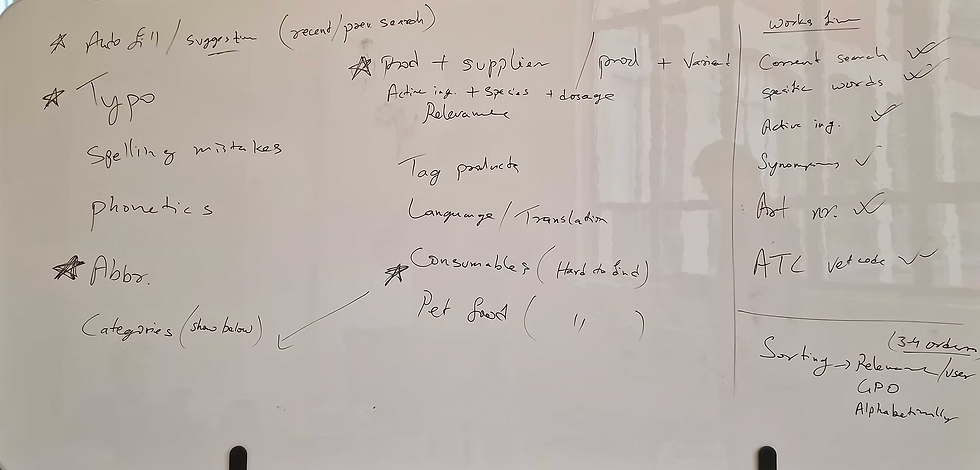
The Blank Slate Fatigue: Every time a clinic logged in, they had to search for their standard supplies from scratch. There was no "quick reorder" functionality.
Complex cart: Users overwhelmed with multiple carts from different suppliers and their ordering conditions (minimum order value, delivery fee, etc).
Complex Approval Flows: In larger clinics, the person building the cart was not the person with purchasing authority, causing carts to sit and expire.
.png)
Strategy & Ideation
Wearing my Product Owner hat, I prioritised the pain points based on the effort-to-impact ratio. We decided to focus on Frictionless Reordering and Smart Triggers. I mapped out the new user journey and facilitated a brainstorming workshop with the development team.
Proposed Solutions
One-Click Reorder Dashboard: A personalised dashboard highlighting previously / frequently purchased items with one click to add in cart.
Automated Inventory Reminders: Email and in-app triggers predicting when a clinic needed to restock based on their previous order volumes.
Shared Clinic Carts: A feature allowing vet techs to build a cart and send a one-click approval request to the head veterinarian.

Delivery Process
To quickly validate the decision and move from idea to feedback, I leveraged AI tools to rapidly prototype the solution. Instead of going through a traditional, time-intensive design process, I used AI-assisted vibe coding to generate a clickable UI that closely simulated the intended experience.
I used Lovable with my figma designs to restructure the logged-in welcome page. The focus shifted from "Discover New Products" to "Manage Your Clinic's Inventory."
Design Choice: I used large, clear typography and high-contrast buttons, keeping in mind that clinic managers are often multi-tasking and glancing at screens in bright, fast-paced environments.
Usability Testing
Lovable high fidelity output helped me to test the idea easily with few users and get real time insights.
Feedback: Users loved the "One-Click Reorder" but found the "Shared Cart" feature slightly confusing.
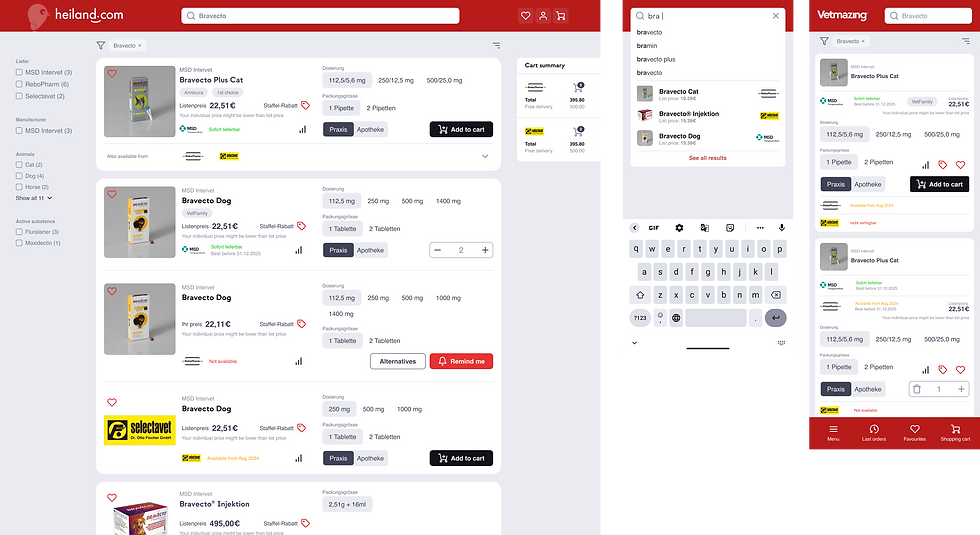
Iteration: I simplified the cart page by adding a prominent card layout for each suppliers with checkout option and supplier logo as sticky on top.
Development & Delivery
As the Product owner, I broke the final designs down into user stories, managed the backlog in Jira, and led the sprint plannings. By maintaining close collaboration with the engineering team, we ensured the designs were implemented accurately without scope creep.
We launched the features as an A/B test to a segment of the dormant user list, paired with a targeted "Welcome Back" onboarding campaign with tooltips to show new design.

Branding update
Due to critical accessibility issues, such as low contrast between the green CTA on a red background and an inconsistent font hierarchy, I identified the need to revisit the visual foundation of the product. These issues not only affected readability but also reduced the overall usability and clarity of key actions.
To address this, I reworked the branding by introducing a more accessible and cohesive colour palette, ensuring sufficient contrast across all UI elements in line with accessibility standards. In parallel, I refined the typography system by establishing a clear and consistent hierarchy, improving scalability and content structure.
This led to the creation of a new design system that brought consistency, accessibility, and scalability to the product, making it easier for users to navigate and for teams to build and maintain moving forward.

Results & Impact
The data from the post-launch phase proved that reducing cognitive load and predicting user needs directly drives retention.
Not only 60% of targeted dormant accounts made a purchase within the first 30 days but also we gained 1200 new users with the new features launching.
Time on Task: The average time taken to complete a repeat order decreased from 18 minutes to 3 minutes.
Revenue Impact: Monthly recurring revenue (MRR) from existing cohorts increased by 55%.

Key Learnings
B2B users prioritise speed over discovery: Unlike B2C e-commerce, veterinary professionals don't want to "shop around". They want to execute their tasks efficiently and get back to their patients.
The power of wearing two hats: Managing the product backlog as a Product owner allowed me to be highly pragmatic, as the designer. I knew exactly what development resources we had, which allowed me to design ambitious yet technically feasible solutions.


Next steps...
To genuinely improve the purchasing experience for veterinarians, the platform needed to provide real-time visibility into supplier data:
-
Product details
-
Negotiated price
-
Delivery status
-
Stock amount (low/no stock)
To address this, I focused on designing a supplier portal that created value on both sides. Beyond simply enabling product catalogue updates, the portal provided suppliers with clear insights into product and campaign performance. The goal was to make the platform not just a requirement, but a preferred tool, an efficient alternative to managing their own online shop...
